
A golfer can feel pretty good on the first tee and completely different by the 14th hole.
One of Dr. Andrea’s patients’ experiences involved a golfer with a long history of lower-back and hip stiffness who could play, but gradually tightened and fatigued as the round went on. The problem became limiting enough that he turned down a multi-day golf trip because he did not believe his back could handle consecutive rounds.
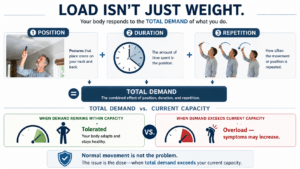
That story illustrates something we talk about frequently: capacity is not just whether you can perform an activity once. It is whether you can tolerate the total dose.
A round of golf is a lot of repeated load
Golf combines repeated trunk rotation, bending, walking, carrying or pushing equipment, standing, and hundreds of smaller movements over several hours.
One swing may feel fine. Ten holes may feel fine. But as the round progresses, muscles fatigue and the total amount of work keeps accumulating.
That is why late-round pain does not necessarily mean the swing on hole 14 injured your back. It may mean the total demand finally exceeded the capacity available that day.
Why does the back start feeling tight?
“Tightness” can mean several things. Sometimes motion is genuinely restricted. Sometimes muscles are fatigued. Sometimes the nervous system becomes more protective as an area gets irritated. Often there is a mixture.
Stretching between every hole may temporarily feel good, but if you need progressively more stretching just to finish the round, we also want to look at strength, endurance, hip motion, trunk control, and the total golf volume you are prepared for.
Golf exposes endurance problems
A patient may have normal strength when tested for a few repetitions in the office but still lack the endurance required for four hours of golf.
This is why rehabilitation should eventually resemble the demands of the activity. If your goal is 18 holes, the plan cannot end at “your back hurts less while sitting.”
What about arthritis or an old injury?
Neither automatically means golf is off limits. An old injury or degenerative change may affect the starting point, but we still look at current function.
Can you rotate comfortably? Can you walk the distance? Can the hips and trunk produce and control repeated movement? How do you recover after a round? Can you play again the next day?
Those questions are often more useful than simply asking whether an X-ray shows arthritis.
How do we build golf tolerance?
Depending on the examination, we may work on hip and spinal mobility, trunk and hip strength, muscular endurance, warm-up strategies, and gradual exposure to more holes or consecutive days.
Chiropractic adjustments, dry needling, or soft-tissue treatment may help selected patients with pain and movement restrictions, but passive treatment should support the larger goal: getting you ready to play the golf you want to play.
Do not make the goal “never feel your back”
For a chronic case, a better first goal may be finishing 18 holes without a major flare, recovering normally afterward, and eventually tolerating back-to-back rounds.
At Rising Sun Chiropractic in St. Peter, we like functional goals because they tell us whether treatment is actually changing the patient’s life.
If your back consistently starts dictating how many holes you play, whether you walk the course, or whether you accept the next golf invitation, that is worth evaluating. The goal is not just to get you through today’s round. It is to build enough capacity that you can keep saying yes to the game.