
When the Goal Isn’t a Cure — It’s Staying Active With a Chronic Injury
There are patients I treat who have injuries that are probably never going to completely disappear.
That doesn’t mean we stop trying to improve, and it doesn’t mean we have nothing useful to offer.
Sometimes the goal of care changes from “make this problem go away forever” to “help this person stay as active and functional as possible despite a chronic problem.”
Some Injuries Leave a Long History Behind
We see this frequently in people who have spent years doing physically demanding work, playing sports, serving in the military, or simply accumulating injuries over a lifetime.
A person may have chronic lower-back problems, limited neck or shoulder motion, old knee or ankle injuries, degenerative changes, recurring muscle tightness, or several of these problems at the same time.
They can have very good days. They can exercise, work, travel, hike, play with their kids, and live a normal life.
But increasing their workload, sitting too long, traveling, doing an unfamiliar activity, or simply accumulating enough physical stress can bring symptoms back.
For these patients, expecting every old problem to permanently disappear may not be realistic. That doesn’t mean we stop trying to improve. It means we define improvement differently.
More Good Days Than Bad
One of the ways I think about chronic musculoskeletal care is pretty simple:
Can we help you have more good days than bad ones?
Can we keep your back moving well enough to work?
Can we keep your shoulder mobile enough to exercise?
Can you walk, hike, hunt, garden, travel, or play with your kids without constantly paying for it afterward?
Can we recognize a decline early enough that a relatively small intervention helps rather than waiting until you’re in the middle of another major flare-up?
Those are meaningful outcomes even if an MRI, an old injury, or an arthritic joint doesn’t magically return to normal.
What Chronic Injuries Have Taught Me About Function
We currently care for several veterans whose musculoskeletal problems began during their military service. Their stories are a good example of something I see across many people living with chronic injuries.
The details are different, but the overall pattern is remarkably similar: years of heavy physical demands, old injuries, chronic restrictions, and symptoms that fluctuate depending on what they’re asking their bodies to do.
Several of these veterans have told their VA providers that when they can receive chiropractic care periodically, they feel better able to live their lives and manage their symptoms with less reliance on pain medication or strong anti-inflammatory medication.
I want to be careful with what that means. I’m not saying chiropractic replaces medication, and I’m not saying we cured the injuries they sustained during service.
I’m saying these patients report that periodic conservative care is one of the tools that helps them remain functional.
To me, that is a worthwhile goal.
Treatment Can Help Without Being a Cure
Healthcare is full of treatments that improve function or quality of life without permanently eliminating the underlying condition.
Musculoskeletal care shouldn’t have to meet an impossible standard to be considered useful.
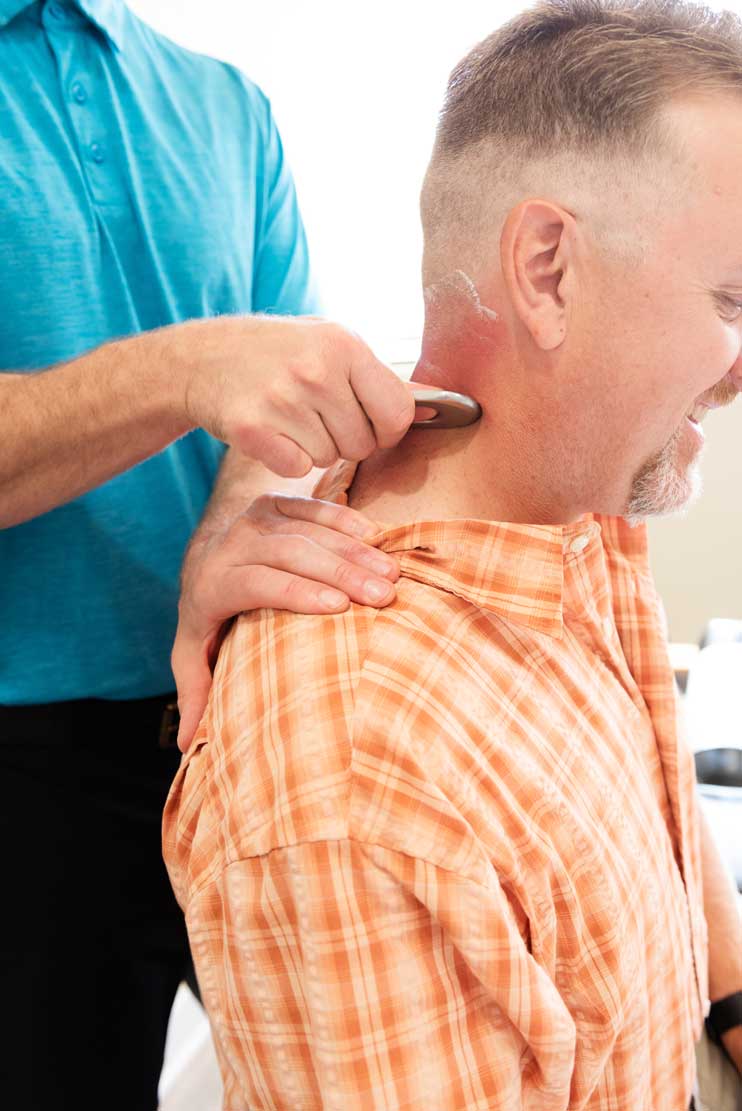
If a chronic problem responds to a combination of movement, strength, exercise, chiropractic care, soft-tissue treatment, massage, laser therapy, or other conservative strategies, we can use those tools appropriately.
The important question is whether they are producing meaningful benefit.
We Still Want You Moving and Getting Stronger
Supportive treatment shouldn’t replace what the patient can do for themselves.
Movement matters. Strength matters. Appropriate loading matters. Recovery matters.
For chronic or previously injured tissues, I generally want to maintain as much comfortable motion, strength, and activity tolerance as possible.
Treatment may help us restore or maintain motion. Soft-tissue work may help an area move more comfortably. Exercise helps build active strength and capacity. Then the patient needs to use that capacity in real life.
The goal is not to protect someone from using their body. It’s to keep building a body that can handle as much of their life as possible.
What About Degeneration?
Joint tissues benefit from movement and appropriate loading. When someone has an old injury or degenerative changes, I would rather help that person maintain useful movement, strength, and function than accept losing those things simply because they’re getting older.
But there is a difference between that goal and promising that treatment can stop arthritis or reverse structural degeneration.
I don’t make that promise.
Our job is to work within what we can actually influence: movement, strength, activity tolerance, symptom behavior, recovery, and function.
What Does Successful Chronic Injury Care Look Like?
Not everyone with an old injury needs regular treatment. Some people learn what they need to do, become stronger, and manage very well on their own.
For others, the history tells us something different. They may repeatedly lose motion, become increasingly symptomatic, or have predictable flare-ups that interfere with life.
If a combination of getting adjusted, having the muscles worked on, exercise, decompression, laser therapy or another conservative approach consistently helps someone feel better, sleep better, exercise harder and keep doing the daily activities that give them purpose, then we’re accomplishing something meaningful.
The question isn’t whether we made an old injury disappear. The question is whether the person is functioning better because of what we’re doing.
And we should still use the least intervention necessary to accomplish that goal.
Aging With a Body That Has a History
I’m 47. I can identify several joints in my own body right now that have a history.
They don’t always move perfectly. Sometimes they hurt. Depending on what I’ve been doing, I may benefit from an adjustment, massage, laser treatment, exercise, or simply changing what I’m doing for a few days.
I don’t interpret that as my body failing. It’s part of managing a body that has been used for 47 years.
The goal isn’t to make it 20 again.
The goal is to keep it capable.
For me, that means continuing to lift, hunt, work, travel and do the things I want to do. Someone else’s list will be different. That’s why function has to be defined by the person, not just by an X-ray or a pain score.
The Goal Is Lifelong Function
For a patient with a straightforward injury, success may mean treating the problem and never needing us again.
For someone living with a chronic injury, success may look different.
It may mean continuing to work. Continuing to exercise. Continuing to travel. Continuing to play with your kids or grandkids. Having fewer significant setbacks. Managing symptoms without allowing them to dominate your life.
Sometimes the best outcome isn’t a cure. It’s maintaining the highest level of function possible with the least amount of intervention necessary.
Chronic Injury Care in St. Peter, Minnesota
If you’re living with an old or recurring musculoskeletal problem, the first question shouldn’t automatically be how often you need treatment.
We need to understand the problem, what you’re trying to do, what you’ve already tried, what you can currently tolerate, and what actually improves your function.
From there, we can determine whether active treatment, rehabilitation, occasional supportive care, or simply a better self-management plan makes the most sense.
That’s the approach we take at Rising Sun Chiropractic + Weight Loss in St. Peter.