
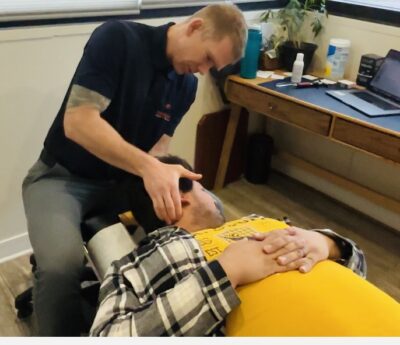
Quick Summary: The “Stuck Neck” Survival Guide
-
What it is: Likely Acute Torticollis—a protective muscle spasm usually caused by a minor joint irritation or sleeping awkwardly.
-
Is it serious? While the pain is intense (often 8/10 or 9/10), it is rarely a sign of permanent damage.
-
The Golden Rule: Do not force your head straight. Move only in directions that feel “safe” or less painful.
-
Recovery Time: Most cases see significant improvement within 48–72 hours with gentle movement and heat/ice.
-
When to see us: If the pain hasn’t shifted after 48 hours, or if you feel numbness/tingling in your arm.
- When to see the doctor: If you have dizziness, weakness, or loss of use of your arms.
“My Neck Is Stuck and Won’t Move”—What is happening?
If you woke up with a stiff neck stuck to one side, you know how intense the pain can be:
- You wake up and your head is tilted to one side
- It feels like something is pulling your neck and won’t let go
- Trying to straighten your head causes sharp or shooting pain
- You can’t find a comfortable position to sit, stand, or sleep
- Even small movements feel intense or unsafe
Some people describe it as:
“It feels like my neck is locked.”
“Like something is stuck or caught.”
“If I move the wrong way, it spikes immediately.”
This is often called a severe stiff neck or acute torticollis.
It feels extreme—but in most cases, it’s not dangerous and does improve. If you are Seeking Relief for a Stiff Neck in St. Peter, MN, this guide will help.
What’s Actually Causing Your Neck to Get Stuck
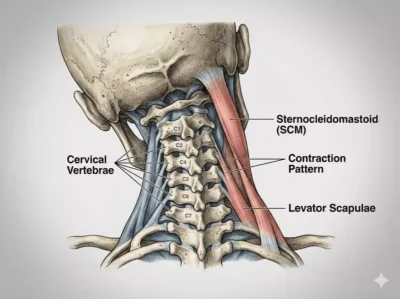
Image courtesy of Freedom Clinics, London / CC BY 4.0
This isn’t usually one single injury. It’s a combination of things happening at once.
1. A Joint Becomes Irritated or “Locked”
The small muscles in your neck help guide movement and help create stability.
Sometimes:
- the joints get irritated
- the joints start getting swollen and don’t move smoothly
- a small part of the joint capsule gets stuck inside the joint can get pinched
- systemic inflammation, dietary and metabolic stresses.
This creates the feeling that your neck is physically “blocked” and makes it feel like you can’t move.
2. Muscles Clamp Down to Protect You
Your body reacts quickly to protect the area.F
- muscles tighten on one side
- your head gets pulled into a tilted position
- the opposite side gets stretched and sore
This is why it feels like your neck is being pulled and won’t release.
3. Your Nervous System Becomes Highly Sensitive
Now your system starts reacting strongly to the pinch, swelling and joint change.
- one direction feels sharp and unsafe
- another direction feels slightly better
This creates that “I can’t move that way at all” feeling.
Why the Pain Feels So Severe (Even If It’s Not Serious)
This is the part that scares people.
The intensity of pain does not mean something is seriously damaged.
Your neck is:
- highly mobile
- packed with nerves
- designed to protect important structures
So when something is irritated, your body turns the alarm way up.
That’s why this can feel:
- sharp
- overwhelming
- constant
Even though most cases are temporary and mechanical.
Before you try to move, sit tall in a supportive chair. Use a mirror if possible to watch your shoulder alignment.
What this tells us:
If you can rotate 50% more toward one side than the other, your body is in a classic “protective spasm.” This information is incredibly helpful for us during your consultation to determine which specific joint is locked.
Real-Life Situations That Trigger This
This doesn’t just happen randomly.
Common triggers include:
- Sleeping in an awkward position
- Falling asleep on the couch
- Long hours at a desk with poor posture
- Sudden head movement (like backing up a car)
- Stress and muscle tension building over days
- Work or workouts involving repetitive upper body movement
Often, it builds quietly—then shows up all at once.
What Actually Helps (And What Makes It Worse)
Most people try to force their neck back to normal. Ouch!
That usually delays recovery, is stressful and with a small change in strategy you can start feeling better.
What Helps
- Move in the “less painful” direction
Don’t force the blocked side to move. Use the movements that feel ok to start. - Use small, frequent movements
Think gentle motion—not stretching or forcing. No movement should reach a 4/10 (no wincing, no holding breath, no sweating, no progressing pain. - Apply heat and ice to reduce muscle guarding
10–15 minutes, a few times per day. - Stay lightly active
Short walks and position changes help more than lying still all day. Rest is rust. Making your day about gentle activity, frequent posture breaks, and movement helps this kind of injury the most. - Find a “good enough” sleep position
Support your neck. Don’t force it straight. Sleep will be difficult for the first 3-5 days. This injury is hard to get comfortable.
What Makes It Worse
- Aggressively stretching into pain
- Forcing your head upright or straight
- Having someone pull or “crack” your neck
- Staying in one position for hours
- Trying to push through sharp pain
If it feels like you’re fighting your body, you probably are.
When we treat injuries like this in the office, we work on finding movements and stretching positions that relieve pain, soft tissue therapies that reduce spasm, and mobilizing key joints in your neck and upper back to speed up the healing process. We recommend never forcing movement, no heavy cracking adjustments. Keep it gentle.
How Long Does a Severe Stiff Neck Last?
Typical pattern:
- First 1–2 days: very painful and limited
- Days 2–4: gradual improvement in movement
- Within 1 week: noticeable relief
Even severe cases often resolve on their own, though they don’t feel like they will when you’re in it.
When Should You Actually Be Concerned?
Most cases improve without intervention.
You should consider getting help if:
- Pain isn’t improving after several days. In our experience, if you are in pain for more than 3 days, we can help.
- You can’t find any direction that feels better after 48 hours; get this checked.
- Pain travels down your arm; this should be checked out right away.
- You notice numbness, tingling, or weakness; this should be checked out right away.
- This keeps happening repeatedly
Why This Might Keep Coming Back
If you’ve had this more than once, it’s usually not random.
It often points to:
- underlying movement restrictions
- muscle imbalance
- repeated strain patterns (work, posture, workouts)
Fixing the episode is one thing.
Preventing the next one is different.
The Bottom Line
A neck that feels “stuck” or pulled to one side is one of the most intense pain experiences people have.
But in most cases, it’s:
- a protective response
- not a serious injury
- very recoverable
The key is not forcing it.
It’s:
- calming the system
- restoring movement gradually
- avoiding the urge to overcorrect
This usually improves faster than people expect—once you stop fighting it.
Frequently Asked Questions About “Stuck Neck” or Torticollis
Still feeling “stuck”?
While most cases of acute torticollis improve with the gentle movements mentioned above, you don’t have to suffer through the first few days alone. If your neck hasn’t started moving after 48 hours, or if you want to speed up the recovery process with professional care, we are here to help.
Schedule a Brief Consultation in St. Peter Or call us at 507-934-3333 to see if we can get you in today.
Wondering if it’s more than just a spasm?
The intense “locked” feeling of a stiff neck can be scary, and it’s natural to wonder if you’ve actually pinched a nerve or damaged a disc. Check out the next blog where we break down if it is a Stiff Neck vs Pinched Nerve: How to Tell the Difference.