
Why Did My Back Go Out Picking Up Something So Light?
A patient recently came into our St. Peter office after his lower back suddenly became extremely painful.
What did he do?
He bent over to pick up a garden hose.
That’s it.
No 300-pound deadlift. No fall. No car accident.
A garden hose.
I’ve heard different versions of this story hundreds of times over the years.
“I bent over to put my socks on.”
“I reached into the dishwasher.”
“I picked up the laundry basket.”
“I sneezed.”
“I leaned over to grab something and couldn’t stand back up.”
When something this simple causes severe back pain, it’s easy to think something must have suddenly broken.
Usually, the story is more complicated.
The movement that triggered your pain isn’t necessarily the entire reason your back hurts.
Understanding that difference can help you make much better decisions about what to do next.

Why Can Your Back Hurt After Such a Small Movement?
Your body is designed to handle physical stress.
Every time you walk, lift, bend, work, exercise, or play with your kids, you place load on your muscles, joints, discs, tendons, and other tissues.
That’s normal.
In fact, your body needs appropriate load to remain strong.
rn
Our functional rehabilitation and corrective exercise approach uses graded loading to rebuild strength and improve what your back can tolerate.
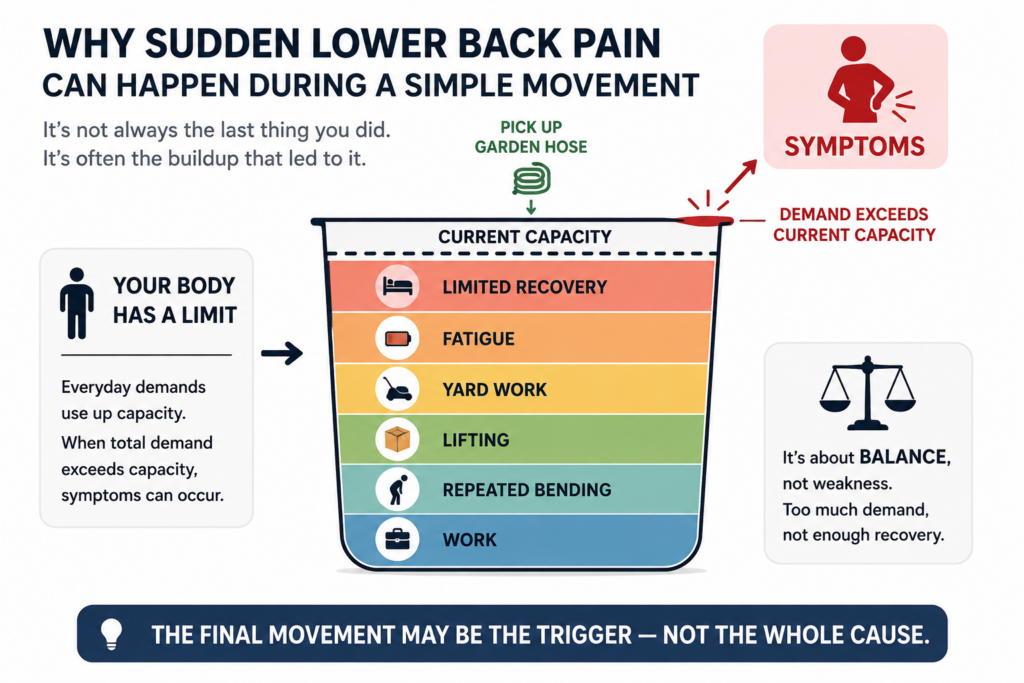
Problems can occur when the amount of stress you’re putting on an area becomes greater than what it can currently tolerate and recover from.
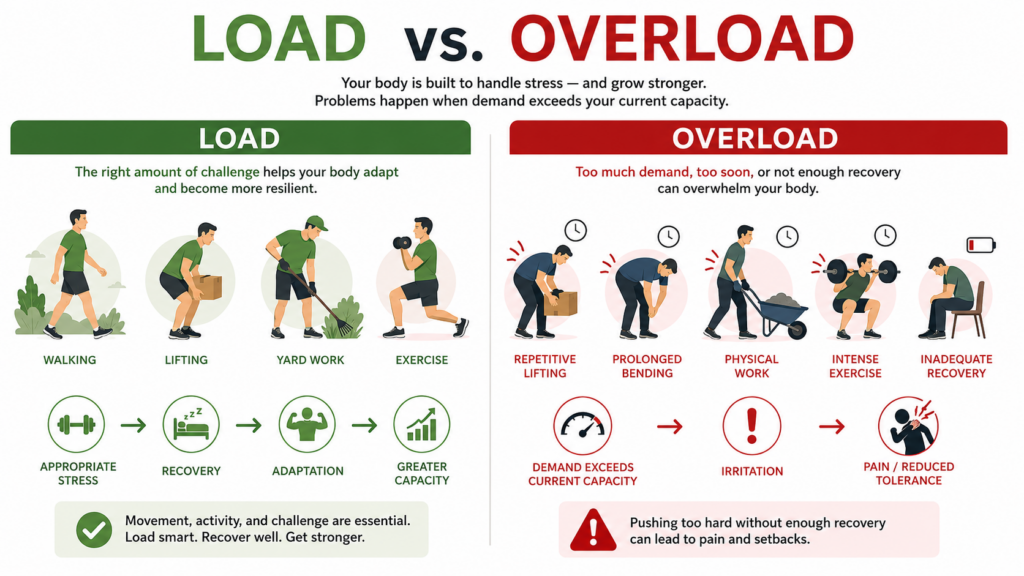
I often explain this to patients as the difference between load and overload.
Load helps us adapt.
Overload exceeds our current capacity and can increase irritation, symptoms, or temporarily reduce what we’re able to tolerate.”
And overload doesn’t always require one enormous event.
It can build through repeated activity.
The “Last-Straw” Effect
Imagine someone who spends an entire day landscaping.
They’ve been:
- Shoveling
- Carrying
- Pulling
- Bending
- Twisting
- Getting up and down
- Working in awkward positions
Their lower back has successfully handled thousands of movements.
Then they bend over to pick up a hose and suddenly experience severe pain.
Did a lightweight garden hose overpower their spine?
Probably not.
The hose may simply have been the last load their already-fatigued back was ready to tolerate that day.
That’s an important distinction.
I don’t want a patient leaving my office thinking:
“My back is so fragile that picking up a hose can destroy it.”
I’d rather they understand:
“My back exceeded what it was prepared to handle. Now we need to help it recover and rebuild that capacity.”
Those are two very different ways of looking at the same injury.
Does That Mean My Back Was Slowly Being Damaged?
Not necessarily.
This is where the explanation can easily go too far.
Your body isn’t a machine with a hidden damage meter slowly moving toward 100%.
Fatigue, previous injuries, unfamiliar activity, poor recovery, sudden increases in workload, prolonged positions, and your current physical conditioning can all influence how much activity you tolerate on a particular day.
Pain itself is also complicated.
The intensity of your pain doesn’t perfectly measure the amount of tissue damage.
I’ve examined patients who could barely get out of a chair and didn’t have any red flags or unusual findings during their neurological examination.
I’ve also examined people with relatively modest pain whose weakness, reflex changes, or other findings made me much more concerned.
That’s one reason the story of how much something hurts isn’t enough by itself.
We also need to know how the body is functioning.
What Actually Happens When You “Throw Your Back Out”?
“Throwing your back out” isn’t a medical diagnosis.
It’s a phrase people use to describe a sudden episode of lower-back pain.
Several structures can potentially contribute, including:
- Muscles and connective tissues
- Spinal joints
- Lumbar discs
- Irritated or sensitive nerves
- A combination of several structures
Your body may also respond to an irritated area by tightening the surrounding muscles.
That’s why people often describe their back as:
- Locked
- Tight
- Crooked
- Spasming
- Stuck
That protective muscle tension can be extremely uncomfortable.
It doesn’t automatically mean something has moved “out of place.”
The important question becomes:
What type of back problem are we actually dealing with?
Muscle Pain, Disc Pain or Nerve Pain?
You usually can’t determine the exact cause of lower-back pain from one symptom alone.
But there are patterns we look for.
Local Mechanical Back Pain
Pain may remain primarily around the lower back and can be aggravated by:
- Bending
- Changing positions
- Lifting
- Sitting
- Standing
- Certain directions of movement
There may be considerable stiffness and muscle guarding without neurological symptoms.
Disc-Related Pain
Disc irritation can sometimes produce:
- Central lower-back pain
- Pain with sitting or bending
- Difficulty transitioning from sitting to standing
- Pain that changes substantially depending on position
- Symptoms that may begin traveling into the buttock or leg
A disc finding on an MRI, however, doesn’t automatically prove that the disc is causing the patient’s current pain.
The examination still matters.
Nerve Involvement
We pay particularly close attention when back pain begins producing symptoms farther into the leg.
These can include:
- Shooting pain
- Burning
- Tingling
- Numbness
- Weakness
That’s one reason I repeatedly ask patients:
“Is the pain staying in your back, or is it traveling farther down your leg?”
Where symptoms are going can sometimes tell us more than simply asking whether the pain is a 5 or an 8.
What Should You Do When Your Back Goes Out?
The first instinct is often one of two extremes:
Do absolutely nothing.
Or:
Stretch the heck out of it until it loosens up.
Neither is my favorite approach.
For many uncomplicated episodes of mechanical lower-back pain, I prefer relative rest combined with tolerable movement.
That means modifying what irritates the area without becoming completely inactive.
1. Start With Short, Comfortable Walks
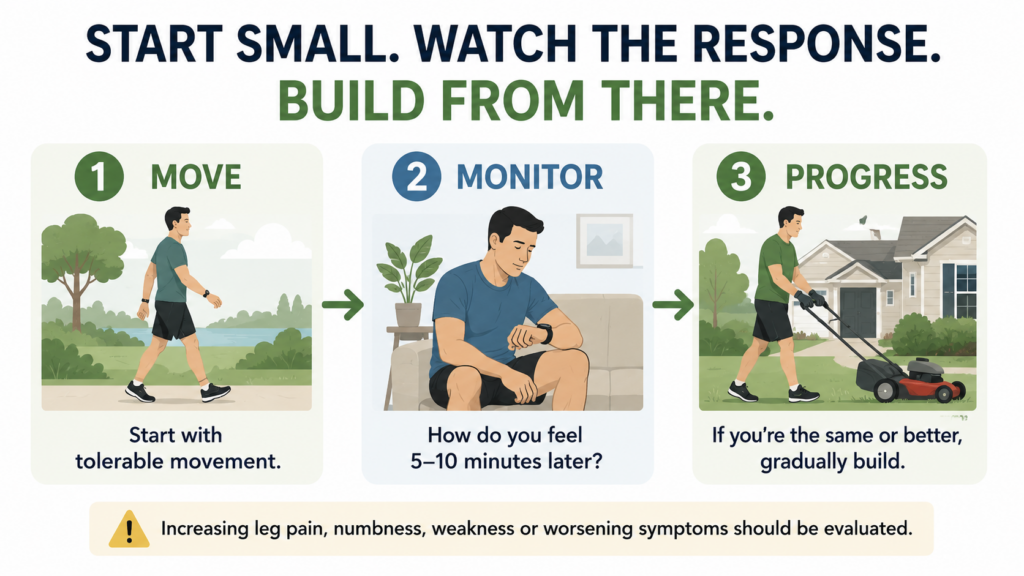
If walking doesn’t increase your symptoms, start small.
That might only mean 5–10 minutes.
Then pay attention to what happens afterward.
Do you feel:
- The same?
- Slightly better?
- Considerably worse?
Your response helps determine the next dose.
One of the rules I frequently give patients is:
Don’t judge an activity only by what happens while you’re doing it. Pay attention to how you feel 5–10 minutes afterward.
If you’re consistently the same or better, we can often gradually progress.
If each attempt leaves you substantially worse, we need to modify what you’re doing.
2. Don’t Aggressively Stretch Into Pain
This is a mistake I see frequently.
Someone’s back hurts, so they immediately start stretching harder.
They pull their knees toward their chest.
Touch their toes.
Twist.
Hang.
Have someone pull on them.
Sometimes it feels good.
Sometimes it makes the problem substantially worse.
Stretching isn’t automatically therapeutic simply because something feels tight.
Muscles can tighten because they’re protecting an irritated area.
If a stretch increases your back pain, causes pain to travel farther into the buttock or leg, or leaves you noticeably worse afterward, don’t keep forcing it because someone told you stretching is good for back pain.
3. Don’t Repeatedly Test the Pain
This is another behavior I see all the time.
Someone bends forward.
“Ouch.”
Thirty seconds later…
They bend forward again.
Still hurts.
Ten minutes later…
They check it again.
Your back doesn’t need to pass a test every five minutes.
During an irritated phase, repeatedly provoking the exact movement that hurts can keep stirring things up.
Move—but don’t spend the entire day trying to prove the pain is gone.
4. Modify Activity Instead of Becoming Afraid of It
If lifting 50 pounds currently hurts, that doesn’t mean:
“I can never lift again.”
It means 50 pounds may currently exceed your tolerance.
Maybe we start with 10.
Then 20.
Then 30.
Eventually we rebuild the ability to handle 50.
This is one of the most important ideas we teach patients at Rising Sun Chiropractic + Weight Loss:
The goal isn’t to protect your back from all stress. The goal is to gradually make your back better at handling stress.
That’s how we build capacity.
How Long Does It Take for a Back Flare-Up to Improve?
There isn’t one universal timeline.
A relatively uncomplicated mechanical episode may begin changing fairly quickly.
A disc or nerve injury may require considerably more time.
A recurrent problem that has happened repeatedly over several years may require more than simply calming the current flare.
That’s why I look at progress in stages.
First: Is the pain settling down?
Can you:
- Get out of bed more easily?
- Stand up from a chair?
- Walk more comfortably?
- Sleep better?
Next: Is movement returning?
Can you bend, turn, sit, stand and perform daily activities more normally?
Finally: Are we rebuilding capacity?
This is the part people frequently skip.
They stop rehabilitation the moment the pain disappears.
But if the same strength, endurance, movement, or workload problem remains, it’s not surprising when another episode occurs six months later.
Pain relief is important. It just isn’t always the finish line.
When Should You Have Sudden Back Pain Evaluated?
Severe pain alone doesn’t necessarily mean something dangerous is happening.
But certain changes deserve more attention.
Seek prompt medical evaluation for symptoms such as:
- New or progressive leg weakness
- Significant or rapidly progressing numbness
- Loss of bowel or bladder control
- Numbness around the groin or saddle region
- Significant trauma
- Fever, chills or systemic illness accompanying unusual back pain
- Unexplained weight loss associated with persistent pain
- Severe pain that behaves very differently from previous episodes
And even without those symptoms, an examination can be useful when pain isn’t improving, keeps returning, or is significantly interfering with work, sleep, walking, or normal daily activities.
How We Evaluate Sudden Lower-Back Pain at Rising Sun
When someone comes into our St. Peter chiropractic office after “throwing their back out,” I’m not simply looking for a joint to adjust.
I want to know:
- What were you doing before it happened?
- What movement triggered it?
- Where is the pain?
- Does it travel?
- Which movements improve or worsen it?
- Is your strength normal?
- Are your reflexes normal?
- Is sensation normal?
- Are there signs of nerve irritation?
- Are there findings that warrant imaging or medical referral?
- What does your work or lifestyle require your back to tolerate?
That information helps determine what happens next.
Depending on the findings, care at Rising Sun may involve a combination of chiropractic care, therapeutic exercise, soft-tissue treatment, spinal decompression, or deep-tissue laser therapy.
Not every patient needs every treatment.
The treatment should match the problem.
The Bigger Goal: Build a Back That Can Handle Your Life
If you landscape for a living, I don’t want to prepare your back to sit on a couch.
It needs to:
- Lift
- Carry
- Bend
- Twist
- Shovel
- Pull
- Work repeatedly
If you’re a parent, your back needs to tolerate kids, laundry, groceries and everything else life throws at you.
If you want to exercise, we need to prepare your body for exercise.
That’s why I don’t particularly like telling patients simply to “be careful with your back.”
I would rather teach them how to build a back that’s prepared for what they’re asking it to do.
Sometimes the first step is calming an irritated back.
The long-term goal is increasing what that back can tolerate.
The Takeaway
If your back suddenly hurts after picking up something ridiculously light, don’t immediately assume your spine is fragile or severely damaged.
That small movement may simply have exceeded what your back was prepared to tolerate at that moment.
Start with tolerable movement.
Don’t aggressively stretch into worsening pain.
Watch where your symptoms travel.
Gradually rebuild activity.
And if symptoms aren’t improving, continue returning, or begin affecting the nerves into the leg, have the problem properly evaluated.
Your goal isn’t simply to make the pain disappear.
It’s to build enough capacity that ordinary life stops exceeding what your body can handle.
Lower-Back Pain Help in St. Peter, Minnesota
If lower-back pain is preventing you from working, exercising, walking, or doing the things you normally enjoy, our team at Rising Sun Chiropractic + Weight Loss in St. Peter can help determine what’s driving the problem and what type of care makes sense.
Frequently Asked Questions About Sudden Lower-Back Pain
Why did my back go out when I barely did anything?
The final movement may simply have exceeded your back’s current tolerance after previous activity, fatigue, or repetitive loading. Severe pain after a small movement does not automatically mean your spine sustained severe damage.
Should I stretch immediately after throwing my back out?
Avoid aggressively stretching into pain. Gentle movement that leaves you the same or better afterward is generally a better starting point. Stop movements that significantly worsen symptoms or cause pain to travel farther into the leg.
Is walking good when your lower back hurts?
Often, yes, provided walking doesn’t significantly increase your symptoms. Short walks can be a useful way to maintain movement during an acute flare. Start with an amount you tolerate and gradually progress.
How do I know if my back pain involves a nerve?
Shooting pain, burning, numbness, tingling, or weakness traveling into the leg can suggest nerve involvement. A neurological examination can help determine whether strength, sensation, reflexes, or nerve tension have changed.
Do I need an MRI if my back suddenly goes out?
Not everyone with acute lower-back pain requires immediate imaging. Your history, examination, neurological findings, trauma history, red flags, and response to care help determine whether imaging is appropriate.