
Why Stretching a Stiff Neck Can Make It Worse
The First Thing Everyone Tries
When your neck tightens up, the instinct is almost automatic:
“I need to stretch this out.”
It feels logical. Something is tight, so you try to loosen it.
Sometimes it even feels better for a moment.
But if your neck is locked, sharp, or highly sensitive, stretching is often the thing that keeps it from improving.
What’s Actually Going On Under the Surface
When your neck is in that “stuck” state, you’re not just dealing with tight muscles.
You’re dealing with a system that’s already overloaded.
Three key things are happening at the same time.
1. Tissue Fatigue
The muscles in your neck—especially the smaller stabilizers—have often been working all day.
Holding your head up.
Stabilizing your vision.
Managing posture during sitting and screen time.
Over time, they fatigue.
And when muscles fatigue, they don’t relax better—they actually become more protective.
2. Tissue Sensitivity
As fatigue builds, the area becomes more reactive.
Normal movement starts to feel uncomfortable.
Certain positions feel blocked.
Small motions trigger larger responses.
This is where people start to feel like:
“Something is wrong.”
But what’s really happening is the system has become more sensitive, not more damaged.
3. Sensitization of the Area
If the irritation continues, the nervous system starts to amplify the response.
That means:
- Less movement triggers more pain
- The area feels guarded
- Recovery takes longer if you keep pushing it
This is where stretching starts to backfire.
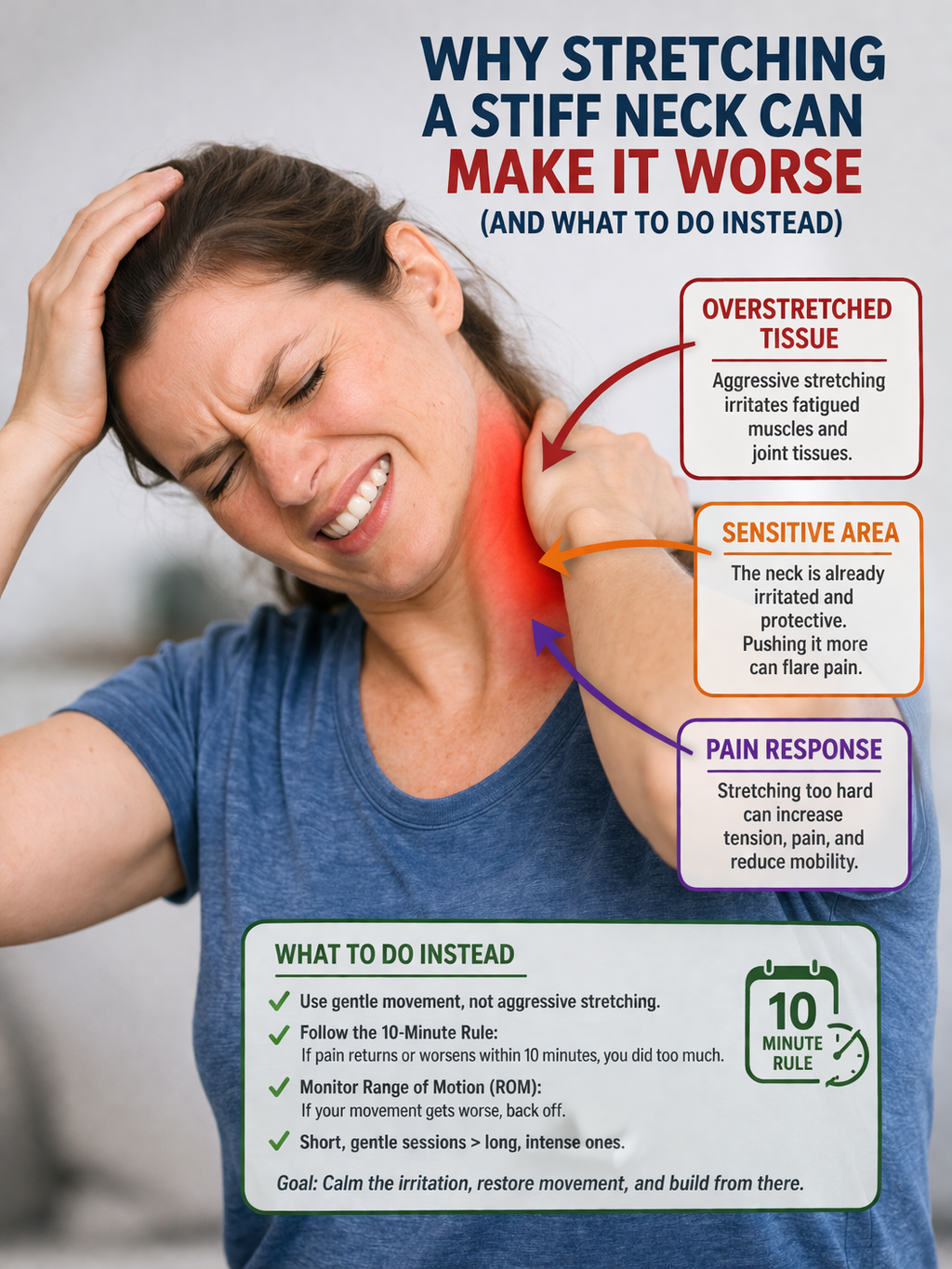
The Better Way: Calming the System
Instead of pulling on sensitive tissue, the goal should be to reduce the “alarm bells” your nervous system is sending.
Gentle Blood Flow (Not Stretching)
Rather than a static hold, try gentle active range of motion. Small, pain-free rotations or “chin tucks” help circulate blood and signal to the brain that movement is safe.
-
The Rule: If it causes a sharp pinch or makes the guarding worse, you’ve gone too far.
The 10-Minute Rule
After performing any movement or functional rehabilitation exercise, check in 10 minutes later.
-
If your pain is lower or the same, the movement was successful.
-
If the area feels more sensitive or “tight” 10 minutes later, the intensity was too high for your current level of sensitization.
When to See a Professional
While most neck stiffness resolves with rest and gentle movement, certain “Red Flags” mean it’s time to get a professional evaluation at Rising Sun Chiropractic:
-
Pain radiating down the arm or into the hand.
-
Numbness or tingling.
-
Sudden loss of strength.
-
Persistent headaches accompanying the neck stiffness.
Summary: Stop Pulling, Start Moving
When your neck is stuck, it’s not a “short” muscle problem; it’s a “sensitive” system problem. By trading aggressive stretching for gentle, frequent movement, you allow the tissue fatigue to recover and the sensitivity to dial back down.
Tired of guessing if it’s a nerve or just a stiff neck? Let’s get a clear answer today.?
What comes after calming down?
Once the sensitivity drops, we move to Isometrics—strengthening without moving the joint.
Strengthening Without Moving: 4-Way Isometrics
Once your neck sensitivity has decreased (using the 10-Minute Rule), the goal is to “wake up” the muscles without irritating the joints.
The Golden Rule: Hold your head perfectly still. Your hands provide the resistance, and your neck muscles match it. Use only 20% of your strength.
Flexion (Front): Place your palms on your forehead. Gently push your head forward into your hands. Resist with your hands so your head doesn’t move.
Extension (Back): Place your hands on the back of your head. Gently push backward as if looking up, but keep your head tucked and still.
Lateral Bending (Sides): Place your right hand above your right ear. Try to tilt your ear toward your shoulder while resisting with your hand. Repeat on the left.
Rotation (Turns): Place your right hand on your right temple. Try to turn your head to look over your shoulder, but use your hand to keep your nose pointed straight ahead. Repeat on the left.
Recommended Dosage:
Hold: 5–10 seconds per direction.
Reps: 3–5 per side.
Frequency: 2 times per day.
Note: Keep breathing! Do not hold your breath during the isometric contraction.