
Neck pain can come from many sources, and the pattern matters. Pain when looking up may be related to repeated or prolonged extension, a previous injury, tight or irritated soft tissues, a disc problem, joint or joint-capsule irritation, spinal stenosis or nerve involvement.
What matters most is when the pain occurs, how quickly it starts, whether repetition makes it worse, whether symptoms travel into the shoulder or arm, and what we find on examination. Those details help determine which structure is most likely being irritated and what type of treatment makes sense.

Why Can Looking Up Make Your Neck Hurt?
Your neck is designed to move. Looking upward is a normal movement, and there is nothing inherently dangerous about cervical extension.
But there is a difference between briefly looking toward the ceiling and spending a long period painting overhead, working above your head, trimming trees, installing lights, or repeatedly moving in and out of that position.
When you look up, the joints, muscles and other tissues of the neck have to tolerate that position. The longer you hold it—or the more often you repeat it—the greater the demand.
That’s why I like to think about physical load as more than weight:
Position + Duration + Repetition = Demand
The position itself may be completely normal. The problem can occur when the total demand becomes greater than what your neck currently tolerates and recovers from.
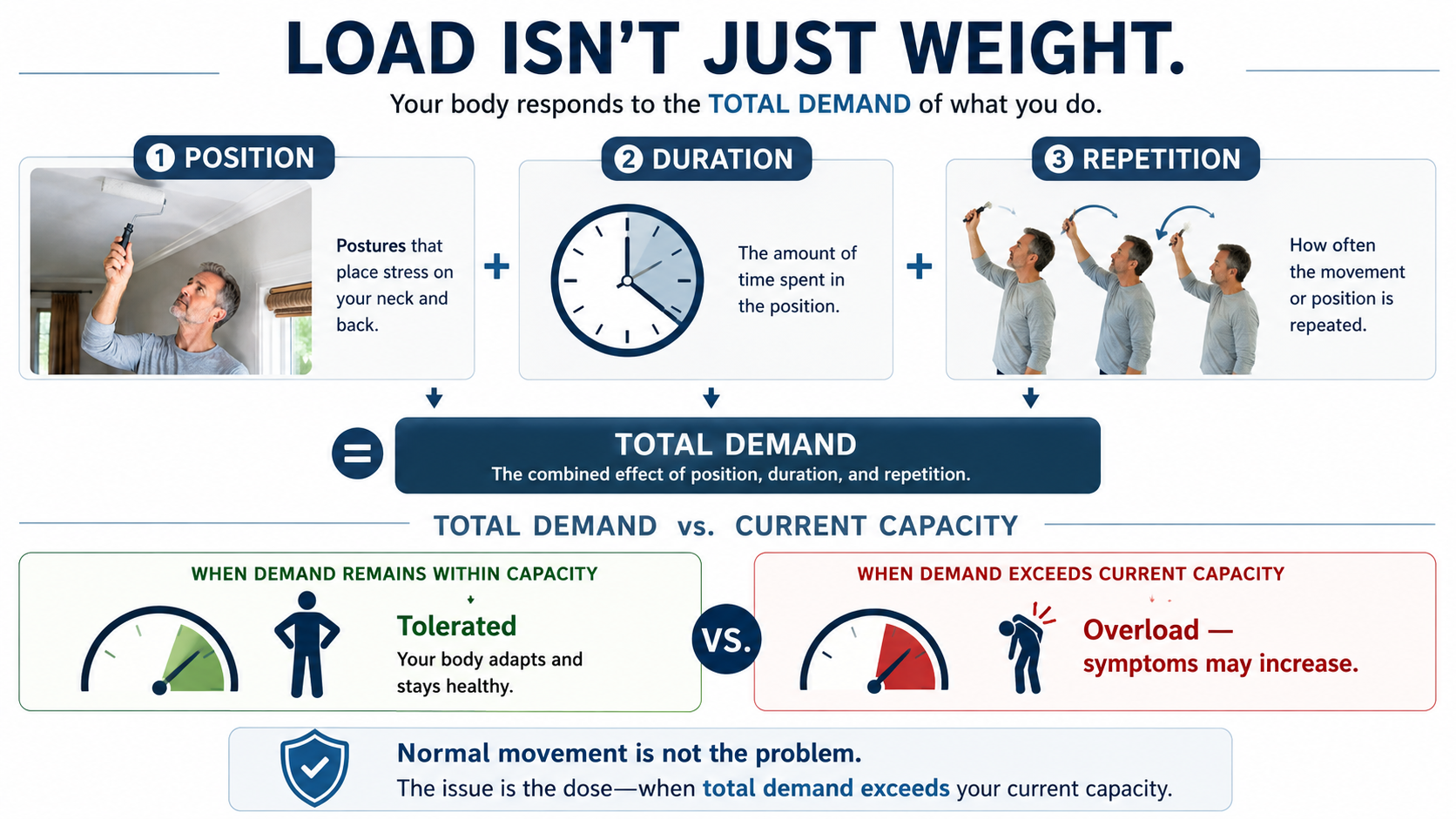
Overload Doesn’t Require a Heavy Object
Most people hear the word “load” and think about lifting something heavy.
But your body experiences many different types of load.
- Holding your head back while painting a ceiling
- Looking downward at a phone for a long period
- Repeatedly turning your head while working
- Sitting in one position for several hours
- Working overhead
- Performing an unfamiliar activity for much longer than usual
None of those activities is automatically harmful.
In fact, we want our bodies to be able to tolerate different positions and activities.
The question is whether the dose of that activity exceeds your current capacity.
This is the same load-and-capacity concept we discuss with lower-back pain. In our guide on why a back can suddenly hurt after picking up something light, the final movement isn’t necessarily the entire story. Previous activity, fatigue, conditioning and recovery can all influence what someone tolerates on a particular day.
Why Does My Neck Feel Stiff Afterward?
When an area becomes irritated, people commonly notice more than pain.
The neck may feel:
- Stiff
- Tight
- Restricted
- Sore at the end of a movement
- Difficult to turn in one or both directions
Sometimes the surrounding muscles become more guarded or tense. Sometimes particular joint movements become sensitive. Often there is a combination of factors.
That doesn’t automatically mean something is “out of place.” It also doesn’t mean the neck has become fragile.
It means we need to understand which movements are limited, what reproduces the symptoms, and if we are starting to see changes to the nervous system.
Why Can Turning My Head Hurt Too?
A person may aggravate the neck while looking upward but later notice that rotation is also restricted.
That’s not unusual.
All movement is connected; the joints, nerves, and muscles that help you look up help turn and bend too.
Once an area becomes irritated and guarded, several directions may become uncomfortable even if one particular activity started the problem.
That’s why an examination should look at more than the one movement the patient initially complains about.
Is It a Muscle, Joint, Disc or Nerve?
You usually can’t determine the exact source of neck pain from one symptom alone.
Muscles, cervical joints, discs and irritated nerves can produce overlapping symptoms.
What helps us sort through those possibilities is the pattern.
We look at things such as:
- Which movements reproduce the pain?
- How much motion has been lost?
- Is the pain staying in the neck?
- Does pain travel into the shoulder or arm?
- Is there numbness or tingling?
- Has strength changed?
- Are reflexes and sensation normal?
- Did symptoms begin after trauma?
- Are there other symptoms that don’t fit a straightforward mechanical neck problem?
The examination matters because two people can both say, “My neck hurts when I look up,” while having very different problems.
Neck Pain vs. Symptoms Into the Arm
One distinction I pay particular attention to is whether symptoms remain localized to the neck or begin traveling into the shoulder, arm or hand.
Local stiffness and pain with movement can behave very differently from a problem involving a cervical nerve.
Arm symptoms can include:
- Shooting or electric pain
- Burning
- Numbness
- Tingling
- Weakness
That doesn’t automatically mean something dangerous is happening, but it changes what we need to evaluate.
Our neck pain treatment page explains more about the different types of neck complaints we evaluate in our St. Peter office.
Should I Stretch a Stiff Neck?
Not necessarily harder.
When something feels tight, the instinct is often to stretch it aggressively until it loosens.
But tightness can sometimes be a response to an irritated or sensitive area. Repeatedly forcing the exact movement that hurts may simply keep provoking it.
I generally prefer finding movement that is tolerable and then watching the response rather than assuming more stretching is always better.
We go deeper into this in our guide, Why Stretching a Stiff Neck Can Make It Worse.
What Should I Do If Looking Up Is Aggravating My Neck?
For an uncomplicated mechanical neck flare, the answer usually isn’t complete rest.
Instead, start by temporarily reducing the dose of the activity that’s aggravating it.
If painting overhead for 45 minutes causes symptoms, that doesn’t necessarily mean you should never look upward again.
It may mean 45 continuous minutes currently exceeds your tolerance.
You might break the work into shorter periods, change positions more frequently, use a different setup when possible, and continue comfortable neck movement rather than repeatedly forcing painful end ranges.
The goal isn’t to protect your neck from movement. The goal is to gradually rebuild the amount of movement and activity your neck can comfortably handle.
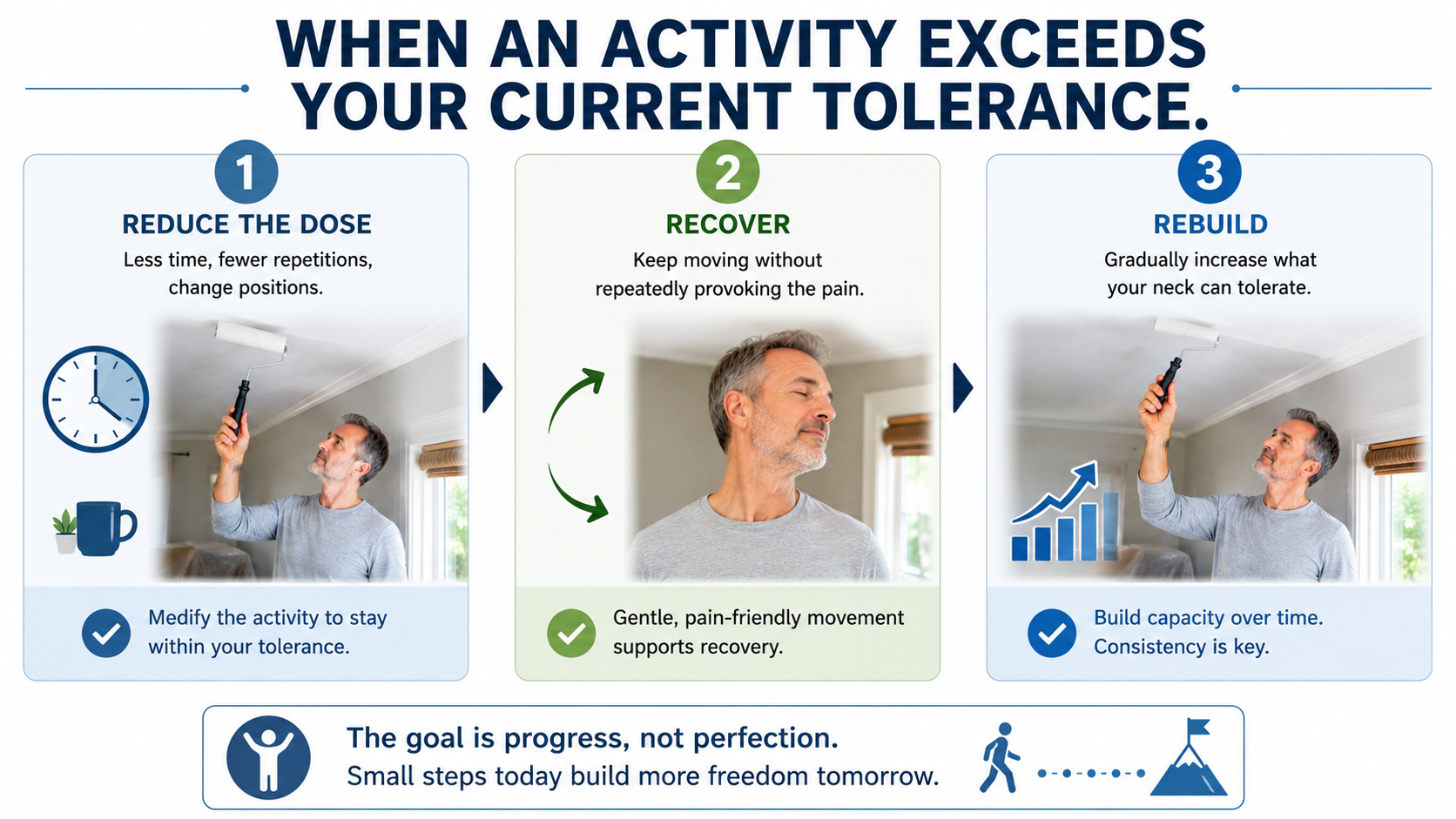
Recovery Matters Too
What you can handle won’t be the same every day. Stress, sleep, and the previous day’s activity all blend into what you can handle.
Your tolerance for an activity can be influenced by what else you’ve been doing, how conditioned you are for the task, how abruptly the workload increased, and how well you’ve recovered between bouts of activity.
This is why someone may tolerate an activity perfectly well one day and struggle with a similar activity after several unusually demanding days.
It doesn’t mean the body is accumulating damage every time it works.
It means demand and recovery need to stay reasonably matched.
As symptoms settle, we gradually expose the neck to more of the movements and activities it needs to perform.
How We Evaluate Neck Pain at Rising Sun
When someone comes into our St. Peter chiropractic office because looking up or turning the head hurts, I’m not simply looking for a place to adjust.
I want to understand:
- What activity started the problem?
- How much time were you spending in that position?
- Which directions are now limited?
- What happens when we reproduce those movements?
- Is the pain staying in the neck or traveling into the arm?
- Are strength, sensation and reflexes normal?
- Are there findings that warrant imaging or referral?
- What does your work, recreation or daily life require your neck to tolerate?
Depending on the findings, care may involve a combination of chiropractic care, therapeutic exercise, soft-tissue treatment, cervical spinal decompression, or deep-tissue laser therapy.
Not everyone needs every treatment. The treatment should match the problem.
When Should Neck Pain Be Evaluated?
Consider having neck pain evaluated when it isn’t improving, continues returning, significantly limits normal activity, or is disrupting sleep.
More urgent medical evaluation may be appropriate when neck pain follows significant trauma or occurs with concerning neurological or systemic symptoms such as progressive weakness, major changes in sensation or coordination, loss of consciousness, fever or other unusual symptoms.
The point isn’t to make every episode of neck pain frightening. Most neck complaints we see do not present with those findings.
The point is to recognize when the story no longer looks like a straightforward mechanical problem.
The Bigger Goal: Build a Neck That Can Handle Your Life
If your job requires overhead work, we don’t want the long-term answer to be “never look up.”
If you paint, garden, work on your house, exercise, hunt, work at a computer or spend time doing projects, your neck needs to tolerate the positions those activities require.
Initially, that may mean calming an irritated area and modifying the dose.
Then we rebuild by getting stronger in all movements around the injury.
Recovery isn’t simply getting back to zero pain. It’s restoring enough capacity that the activities you need and enjoy stop repeatedly exceeding what your neck can handle.
The Takeaway
If your neck hurts after painting, working overhead or spending a long time looking upward, don’t automatically assume you seriously injured your neck.
The position may simply have been held or repeated longer than your neck was currently prepared to tolerate.
Reduce the aggravating dose temporarily. Keep moving within a comfortable range. Don’t repeatedly force painful motion just because the area feels stiff. Pay attention to whether symptoms remain in the neck or begin traveling into the arm.
Then gradually rebuild your ability to perform the activity.
Neck Pain Help in St. Peter, Minnesota
If the pain is not settling, repeatedly returns or travels into your arm, an examination can help determine what is being irritated and which movements or treatments are most appropriate.
Frequently Asked Questions About Neck Pain When Looking Up
Why does my neck hurt when I look toward the ceiling?
Looking upward places your neck into extension. The movement itself is normal, but prolonged or repetitive extension can become uncomfortable when the total demand exceeds what your neck currently tolerates.
Can painting a ceiling cause neck pain?
Yes. Painting overhead can combine sustained neck extension, repeated movement and prolonged positioning. That doesn’t necessarily mean the activity damaged your neck, but the dose can temporarily exceed your current tolerance.
Should I avoid looking up if it hurts?
You may need to temporarily reduce how long or how often you use the aggravating position, but complete long-term avoidance is usually not the goal. Comfortable movement can be gradually progressed as symptoms settle.
Why does my neck also hurt when I turn my head?
Once an area becomes irritated or guarded, multiple neck movements can become restricted. An examination can help determine which movements are limited and whether there are signs of nerve involvement.
When is neck pain more concerning?
Neck pain deserves closer evaluation when it follows significant trauma, isn’t improving, or occurs with progressive weakness, substantial numbness, coordination changes, systemic illness or other unusual neurological symptoms.
Written by Dr. Seth Nelson, DC — Rising Sun Chiropractic + Weight Loss, St. Peter, Minnesota.