
Why Pain at the Base of Your Skull Feels So Intense
Why Does It Hurt Right Here?
Almost everyone with neck pain ends up pointing to the same spot.
Right at the base of the skull.
And the way they describe it is usually the same too:
- sharp
- throbbing
- pressure-like
- worse when sitting upright
- worse after time at the computer or device
It often feels stronger than the rest of the neck pain, which is what makes it concerning and can often happen alongside a stiff or locked neck.
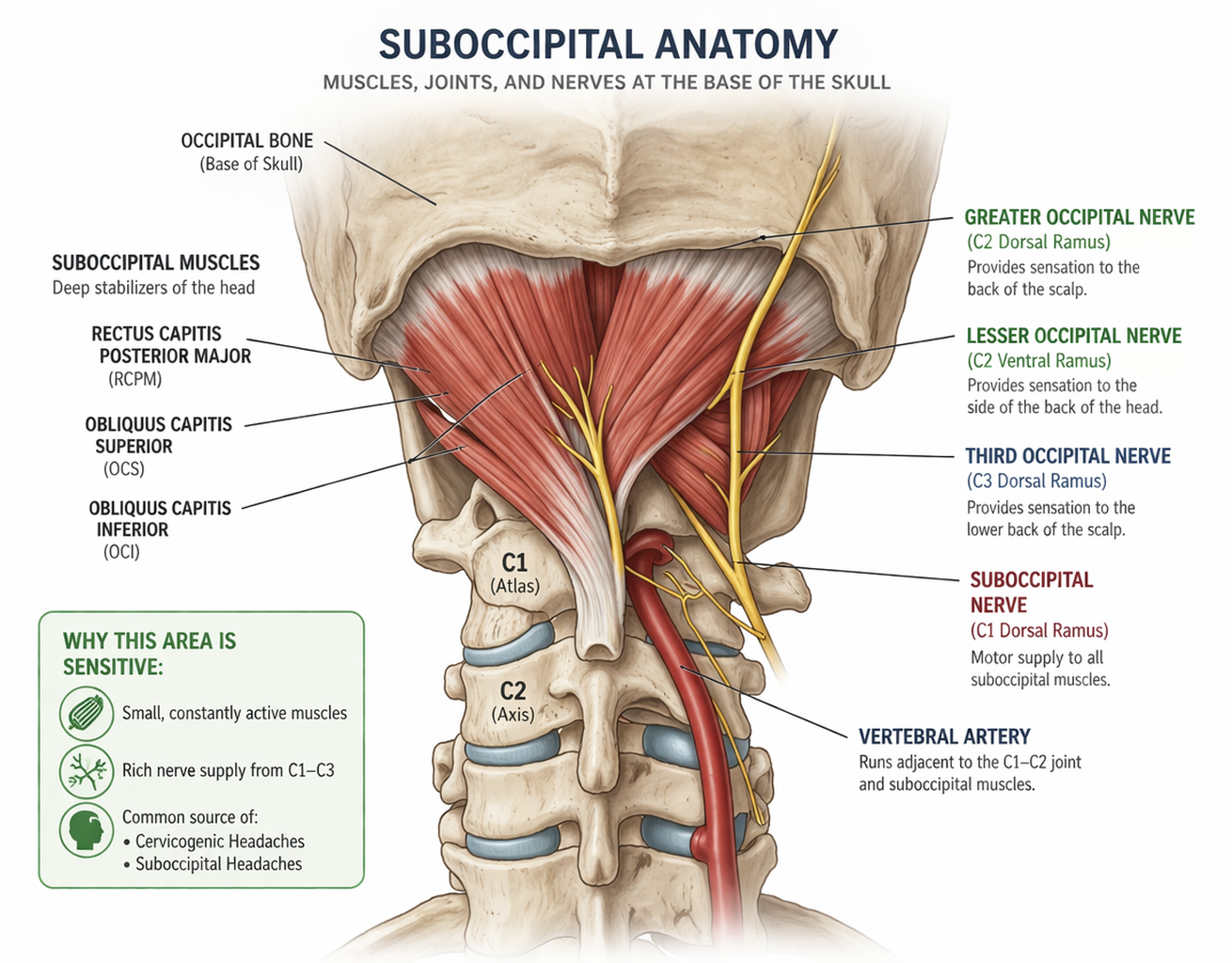
What’s Actually Happening in That Area
That spot is packed with small muscles and joints that are responsible for fine control of your head.
They’re not built for force—they’re built for precision.
So when they get irritated, you feel it quickly and clearly.
Why This Area of the Neck Triggers Headaches
In the image above, you can see the small muscles and nerves that sit right at the base of your skull.
These are called the suboccipital muscles, and even though they’re small, they do a lot of work throughout the day and can be confused with a pinched nerve
They help hold your head up.
They control small movements.
They keep your eyes level when you’re looking at a screen.
That sounds simple—but over the course of a day, it adds up.
What Happens With Prolonged Sitting and Screen Time
If you spend hours sitting—especially at a computer—this area doesn’t really get a break.
Your head is slightly forward.
Your eyes are fixed on one point.
And these small muscles stay “on” the entire time.
They’re not designed for long-duration holding.
They’re designed for fine control and short bursts of activity.
So what happens is:
- the muscles start to fatigue
- they tighten to compensate
- they lose their ability to relax fully
That’s when people start saying things like:
“It feels like pressure building at the base of my skull.”
“It turns into a headache by the end of the day.”
How Muscle Fatigue Turns Into Headaches
As those muscles tighten, they begin to affect the nerves that run through that area.
You can see in the image how closely the muscles and nerves are layered together.
When the muscles become overworked:
- they create compression in the area
- they increase sensitivity of the nearby nerves
- they refer pain upward into the head
This is what we call a cervicogenic headache—a headache that starts in the neck but is felt in the head.
That’s why the pain often:
- starts at the base of the skull
- travels upward
- feels like pressure, throbbing, or a dull ache
Why It Becomes a Repeating Cycle
This doesn’t usually happen once.
It builds over time.
You go through your day:
- sitting
- working
- focusing
The muscles fatigue again.
The tension builds again.
The nerves become more sensitive.
Eventually, it takes less and less to trigger the same headache pattern. This is when people start trying to stretch aggressively.
That’s when people start noticing:
“It doesn’t take much anymore to set it off.”
What Actually Helps Break the Cycle
The solution isn’t to force the area to relax—it’s to change the load on it throughout the day.
That usually looks like:
- breaking up long periods of sitting
- giving your neck short movement breaks
- avoiding staying in one position for hours
Even small changes matter.
You don’t need a perfect posture.
You need less continuous strain.
The Takeaway
This area becomes painful not because it’s damaged, but because it’s overworked and doesn’t get a chance to reset.
Once you understand that, the goal shifts from:
“How do I fix this?”
to:
“How do I stop overloading it all day?”
That’s where most people start to see real improvement.
This often shows up alongside the “stuck neck” pattern we talked about here:
→ Severe Stiff Neck: Why Your Neck Gets “Stuck” and What to Do About It
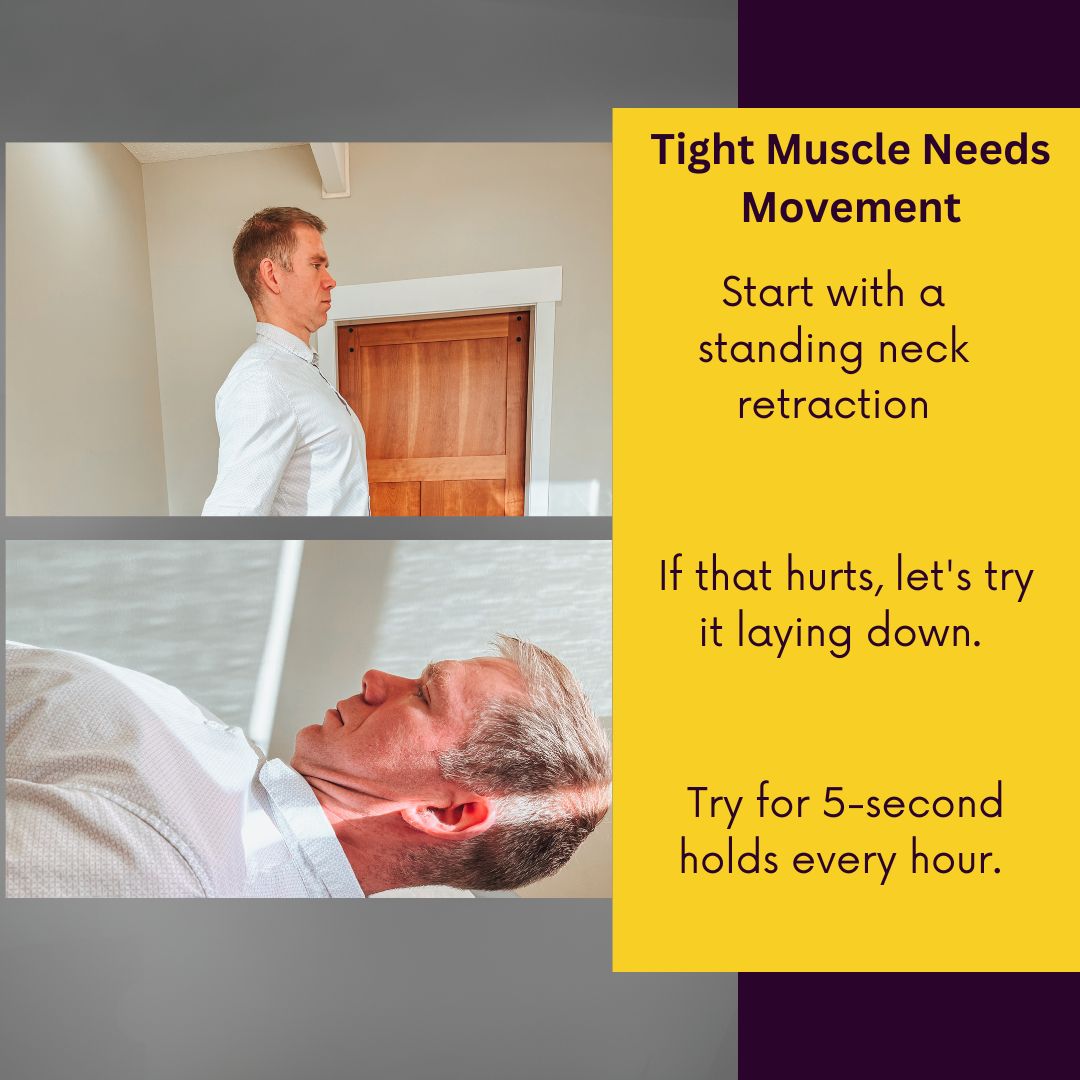
Two Simple Resets to Calm the Base of the Skull
When this area is flared up, we aren’t looking to “strengthen” or “stretch” aggressively. We want to activate the deep stabilizers so the superficial muscles can finally let go.
1. The Deep Neck Flexor “Nod”
Think of this as a micro-movement.
-
The Goal: Wake up the muscles in the front of the neck that support your head’s weight.
-
How to do it: While lying down or sitting tall, imagine there is a rod running through your ears. Gently rotate your chin downward as if nodding “yes,” but only move about an inch.
-
The Key: You should feel the muscles deep in your throat engage, but the large muscles on the sides of your neck should stay relaxed. Hold for 3-5 seconds and repeat 5 times.
2. The Progressive Neck Retraction
This is the “reset button” for hours spent looking at a screen.
-
The Goal: Decompress the joints at the base of the skull.
-
How to do it: Keep your eyes level on the horizon. Gently draw your chin straight back, as if you are making a “double chin.”
-
The Key: Do not tilt your head up or down. Move until you feel a light stretch or “opening” at the base of your skull. Hold for 2 seconds and release.
A Note for My St. Peter Neighbors: If these movements cause a sharp increase in pain or send a “zing” into your head, stop immediately. In an acute torticollis phase, your nervous system is on high alert. If you can’t find a comfortable range of motion, it’s a sign that the joints need a professional evaulation before exercise can be effective.
Why Sitting or Holding Your Head Up Feels Worse
When you sit upright, those same muscles have to work harder.
If they’re already irritated, that added demand feels amplified.
That’s why people say:
“It gets worse the longer I sit.”
What Usually Makes It Worse
Aggressive approaches tend to backfire here.
Things like deep pressure, hard stretching, or forcing posture often increase irritation rather than relieve it.
This is the same reason stretching can slow recovery in a stiff neck episode:
→ Why Stretching a Stiff Neck Can Make It Worse
Why Traditional Advice Often Fails
If you’ve tried to “stretch out” this pain or use a high-pressure massage tool at the base of your skull, you likely noticed it felt better for ten minutes—and then flared up twice as hard.
Here is why: When your neck is in an acute “guarding” phase, the nervous system views aggressive stretching as a threat. Instead of relaxing, the muscles tighten further to protect the joints. This is why we focus on resets rather than stretches.
Your Roadmap to Relief
If you are currently struggling with that intense pressure at the base of your skull, follow this 3 step approach:
-
Audit Your Environment: Take a “movement snack” every 30 minutes. Even standing up for 10 seconds breaks the static load on those suboccipital muscles.
-
Perform the Resets: Use the Deep Flexor Nod and The Progressive Neck retractions 3-4 times a day.
-
Check the Alignment: If the pain isn’t budging, there is likely a mechanical restriction in the upper cervical spine that exercises alone can’t reach.
Visit Us in St. Peter
At Rising Sun Chiropractic, we specialize in helping St. Peter residents navigate acute neck episodes without the guesswork. We look past the symptoms to find exactly which joints are stuck and which muscles are overworking.
Ready to get ahead of the headache? Schedule an evaluation here or call us to see how we can help you break the cycle.